
INTRODUCTION
Every civil government has a criminal justice system in place to uphold the moral standards of its citizens. The criminal justice system enforces the standards of conduct necessary to safeguard persons within the community. Understanding the police is a prerequisite to knowing the criminal justice system. The way the criminal justice system works is by finding, accusing, convicting, and punishing members of the public who violate the law of the land. The criminal justice system’s actions against lawbreakers serve a number of purposes, including removing offenders from society who endanger it, discouraging others from engaging in criminal activity, creating an environment that is favourable to social interaction, and providing society with a chance to rehabilitate lawbreakers and antisocial people into law-abiding citizens.[1]
The Police, the Prosecution, the Judiciary, and the Prison and Correctional Services comprise India’s criminal justice system. Because of the nature of their roles in society, the police continue to be the primary organisation in the criminal justice system. Since police officers are the first to arrive at a crime scene, their involvement is crucial. The confines of a criminal scenario within which legal fights are waged are drawn by the way the policeman applies the law in a particular case. As was already noted, gathering information from the police on facts, evidence, witness examinations, and other pertinent materials greatly impacts the investigation. The basis of the modern police force was established by the strengthening of British rule in India.[2] The Director General of Police is now in charge of a State’s police force. An Inspector General or Deputy Inspector General of Police is in charge of overseeing the administrative operations of each police range, which are the easily navigable geographical divisions within a state. The range consists of many districts. Police stations, circles, and divisions make up the additional divisions of district police. States have independent divisions of intelligence, justice and law, crime, and civil police in addition to their own armed police. The Indian Police Service (IPS) cadres, whose recruitment occurs across India, staff every senior police position in each State. The State is in charge of hiring, promoting, and maintaining cadre control for lower-level positions, ranging from Police Constable to Deputy Superintendent of Police. First and foremost, police work a lot to keep the public order and prevent crime. They also regulate traffic, make preventative arrests, conduct investigations and detection, control crowds, keep the public under control during festivals, stop rioting, and more. In this way, the roles that the police perform are varied.
The Code of Criminal Procedure has several clauses that provide the police latitude in carrying out their duties. According to the laws, they have the authority to look into any offence and file a charge sheet or file a formal complaint.[3]
ROLE OF POLICE
Adaptation of Police in India
The term “Police” originates from the Latin word “Politia,” meaning “Civil Administration.” Contrary to popular misconception, which holds that Indian law is a British invention, India has always understood the existence of the rule of law and the administration of justice, having recognised the Vedas as the pinnacle of Dharma.[4] The first Police Commission was established by the British in 1860, and the majority of its recommendations were included in the Police Act of 1861. Subsequently, the British Parliament approved the Police Act of 1861, establishing the current police system in India. The policy framework is very evident. The whole criminal justice system, including the police force, was set up to uphold the political order that the British had created.
India acquired a well-established legal system upon its independence, which had been established first under British control. one of the most significant responsibilities of the police is now the protection of fundamental rights. The situation has altered since the Indian Constitution was enacted on January 26, 1950. State police commissioners, appointed by several states, have passed state legislation and coordinated state policies to improve the state police system. on the other hand, the Indian police system is founded upon the 1861 Police Act and the 1902 Police Commission’s recommendations. As a result, people today have evolved in accordance with their present circumstances and various historical periods. It is the foundation of national governance at the moment.
provisions UNDER criminal law
Evidence law, procedural law, and substantive law make up Indian criminal law. The Central and State legislatures enacted the Indian Penal Code, 1860 (IPC) and special and local legislations, while the Code of Criminal Procedure, 1973 (Cr PC) and the Indian Evidence Act, 1872 primarily provide the foundation for procedural law. These three significant Acts were passed by the British in the latter part of the 1800s. The Constitution of India is the only major statute to have undergone revision after independence. It was amended in 1973 based on recommendations made by the Law Commission of India.
Various classifications of crimes and their penalties are defined by the IPC. State, armed forces, public authority, public justice, public health, security, religions, human body, property, election-related, money, government stamps, weights and measures, documents and property-related symbols, marriage, and defamation are some of the categories into which offences are separated. There are 330 offences across all of the 511 sections that make up the IPC. [5]
Criminal case registration, investigation, trial, and follow-up procedures are all covered by procedural law, from the filing of the first complaint to the ultimate settlement. The Code of Criminal Procedure contains many procedures that empower police officials. These include the following: the procedures pertaining to the officers’ powers to investigate an officer; arrests made during an investigation; powers of prosecution and attachment; searches and seizures during an investigation; investigations of a cognizable officer; investigations of a non-cognizable officer; police officers’ powers to investigate an officer; and so on.
Functions of Police
The various functions of the police include:
- Patrolling and surveillance
- Making arrests
- Lodging FIRs
- Releasing the accused on bail
- Investigation
- Interrogation
ROLE OF POLICE IN the Court Procedures
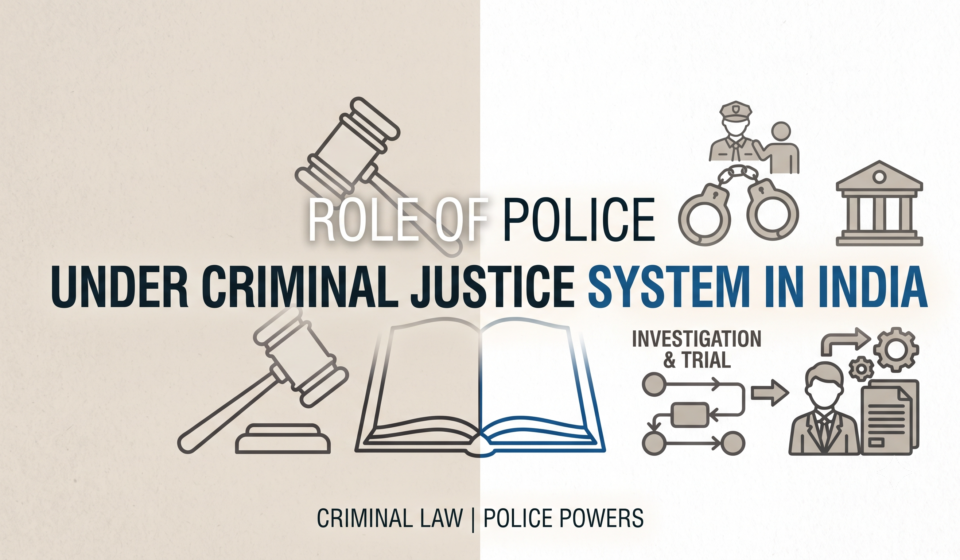
The following are the primary stages and roles of police in the criminal justice process:
1: The First Information Report is registered by the police once they have information about the commission of a cognizable offence. This initiates the criminal justice system’s procedure.
2: After this, the police have an obligation to go to the crime site and look into the case’s facts, analysis of the crime scene, analysis of witnesses and suspects, analysis of the statement, execution of searches, confiscation of property, collection of fingerprints and other scientific evidence, analysis of records and entry of data in the required records, such as case diaries, daily diaries, statistical diaries, etc., putting the accused under arrest, detention, and interrogation.
3: The investigating police officer forwards the report to the magistrate of the jurisdiction after the investigation is completed. The report will be in the form of a charge sheet if there is enough evidence to prosecute the defendant. This report is referred to as the final report if there is not enough proof.
4: The Court accepts jurisdiction upon obtaining the charge sheet and commences the proceedings for the trial.
5: After this, the charges are framed. At this point, the prosecution’s responsibility is to prove the allegations against the defendant beyond a reasonable doubt. Providing the accused with a complete opportunity to present their defence is necessary.
6. In the event that the trial results in a conviction, the court may impose any of the following penalties: a fine, the forfeiture of property, simple imprisonment, rigorous imprisonment, life imprisonment, or the death penalty.
Fundamentals of Policing
The task of preventing and investigating into crimes is given to the police. They are accountable for upholding public order, safeguarding VIPs, and serving as a vital component of state security. To fulfil these responsibilities, the police have been granted broad legal authority. Among them are the authority to search someone’s person and property and to make arrests. Now the police has to begin an investigation and take all legal actions necessary for them to carry out their job. To guarantee that individuals use these privileges appropriately, the law has imposed certain limitations on the practice. Since the establishment of democratic institutions, the people have gained power and the government has acknowledged their fundamental rights. In other words, the primary responsibility of law enforcement nowadays is to uphold the “rule of law,” which is the foundation of a democratic state.
The Role of Police & Judicial Response
The police’s job is to enforce the law and maintain discipline. Thus, the administrative department demonstrates respect for human rights by looking into and appointing officials before looking into and prosecuting those who violate the law in order to pass laws protecting people’s human rights. In a democratic society, it is the state’s responsibility to uphold and protect human rights. The departments of law enforcement, military, justice, and civil affairs are accountable for upholding the human rights of all state institutions, preventing violations of those rights, and taking proactive steps to protect such rights. The role of the police is very crucial in this situation.
Unfortunately, because of the conflict between constitutional and legal rights and the police, the police have a dual obligation to uphold the worth of human rights for many reasons in addition to their legal obligation as defenders of the law while carrying out this task.[6]
In Case of Arnesh Kumar Vs. Respondent: State of Bihar[7] courts are to ensure that police officers do not arrest unreasonable defendants and that magistrates do not allow irregular and mechanical detentions. Further, certain guidelines were also provided with respect to power of arrest of police.
Conclusion
The conclusion is that the police play a significant role in India’s criminal justice system. The Criminal Procedure Code of 1973, the Indian Evidence Act of 1972, and the Indian Penal Code of 1860 govern the administration of justice in India. However, evidence has shown that police work often deviates from the requirements outlined in several criminal statutes. The Indian Penal Code lists crimes and their corresponding punishments. The “what” was done is dealt with under the Indian Penal Code. The police’s harassment serves only to ascertain the “what” of the offence. The police, as an investigating body, have all responsibility for identifying the offender. The Indian Penal Code, for instance, distinguishes between crimes that are cognisable and those that are not. The general consensus is that law enforcement alone has the authority to choose how to categorise a particular offence and may identify it as such. Any individuals involved in crimes and offenders may benefit from the Criminal Procedure Code. Not simply the code but also its regulations are mandatory. According to the legislation, police cannot use impunity, file a false police report, resist an unlawful detention, harass, or coerce suspects. However, the police worldwide use this unusual and dehumanising technique. Everyone, regardless of their involvement in criminal activity.
Although the SC provides guidelines for police officers to carry out their duties in a proper manner, there is a growing necessity for law enforcement officials to adhere to the regulations set forth by the law in order to establish the importance of law enforcement in the criminal justice system and to ensure that the rule of law and order can be upheld without violating human rights.
REFERENCES
[1] P.D. SHARMA, CRIMINAL JUSTICE SYSTEM, 50, (Rawat Publications, Jaipur, 1998).
[2] Sharma, A. (2004). POLICE IN ANCIENT INDIA. The Indian Journal of Political Science, 65(1), 101–110. http://www.jstor.org/stable/41855800.
[3] J.C. CHATURVEDI, POLICE ADMINISTRATION AND INVESTIGATION OF CRIME, 194-199, (Isha Books, Delhi, 2006).
[4] Sharma, A. (2004). POLICE IN ANCIENT INDIA. The Indian Journal of Political Science, 65(1), 101–110. http://www.jstor.org/stable/41855800.
[5] Sekhon, N. (2019). POLICE AND THE LIMIT OF LAW. Columbia Law Review, 119(6), 1711–1772. https://www.jstor.org/stable/26794354.
[6] Belur, J. (2010). WHY DO THE POLICE USE DEADLY FORCE?: Explaining Police Encounters in Mumbai. The British Journal of Criminology, 50(2), 320–341. http://www.jstor.org/stable/43610761.
[7] Arnesh Kumar Vs. State of Bihar, AIR 2014 SC 2756.